

REVIEW · KITESURFING & SURF LESSONS
Kitesurf Lessons in Cape Verde
Kitesurfing starts with a kite on land. This 2-hour session in Sal turns that first taste into a structured lesson, with IKO-qualified coaching that walks you from beach control to your first water skills. You’ll start on the sand at kitebeach, learning kite handling in a way that builds confidence fast.
I really like how the Surf Hub Cabo Verde team, led by Amy, keeps everything friendly and organized. They get your gear ready at the shop, handle the move to kitebeach, and teach in a way that feels both safe and fun.
One thing to plan for: this is hands-on kitesurfing, so you need moderate physical fitness and you must be able to swim. If wind and weather do not cooperate, the schedule can shift since the lesson depends on good conditions.
In This Review
- Key highlights worth knowing
- Before You Fly: Meeting Surf Hub Cabo Verde and Getting Your Gear Ready
- Kitebeach Warm-Up: Small Training Kite Skills on the Sand
- Big Kite Safety Systems: Turning Control Into Real Confidence
- Into the Water: Instructor-Led Bodydragging With the Kite
- Private Lesson Pace: What You Gain With Only Your Group
- Value for $141.14: Is a 2-Hour IKO Lesson Worth It?
- Weather and Timing: Planning Around Wind, Light, and Repeats
- Should You Book This Kitesurf Lesson in Sal?
- FAQ
- How long is the kitesurf lesson in Sal?
- Where does the lesson start, and does it end back at the same place?
- What will I do during the lesson?
- What fitness level do I need, and can I participate if I can’t swim?
- Are the instructors IKO qualified?
- Is this lesson private or shared?
- What happens if the weather is poor or I need to cancel?
Key highlights worth knowing
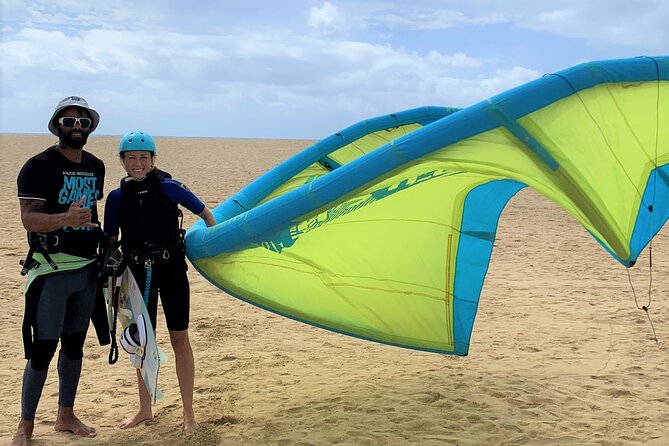
- IKO-qualified instructors: All instructors are IKO qualified, so you get a real training framework, not guesswork.
- Start with a small training kite: You learn kite flying control on the beach before power is turned up.
- Big kite safety systems first: Before you go in deeper water, you practice key safety skills and control.
- Bodydragging with an instructor: You get coached technique while using the kite, not just watching from shore.
- Private group experience: Only your group participates, so you can move at the right pace.
- Amy and the team keep it smooth: From gear prep to getting you to kitebeach, the vibe is helpful and organized.
Before You Fly: Meeting Surf Hub Cabo Verde and Getting Your Gear Ready
You don’t show up and guess your way through kitesurf gear. You meet at Surf Hub Cabo Verde in Santa Maria (Rua 15 de Agosto, 4111). The session starts with a real setup moment at the shop, where they prepare the equipment for your lesson.
That shop time matters more than it sounds. Proper setup helps your first sessions feel calmer, because the kite is less likely to behave like a mystery. It also reduces stress when you’re about to handle lines, harness, and a control system for the first time.
Then you head over to kitebeach. Even if you are the type who likes to arrive early and look around, you will appreciate that the team takes care of the move. It lets you focus on the actual lesson, not logistics.
This is also a good sign of how the school runs. In multiple experiences, Amy and the team are described as accommodating and helpful, and you can feel that here in the flow. You’re not left scrambling, and you’re not stuck waiting around with nothing to do.
Kitebeach Warm-Up: Small Training Kite Skills on the Sand
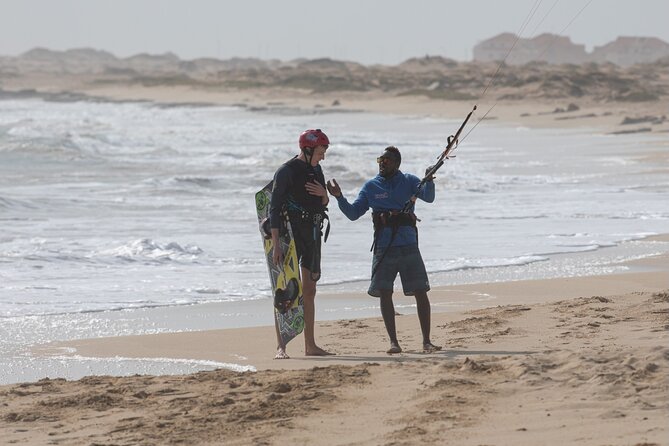
Your first learning happens on the beach with a small training kite. That is a big deal for beginners. A smaller kite lets you practice the essentials without getting overwhelmed by full power.
On the sand, you learn the basics of kite flying and how it feels when you move the kite correctly. This stage is about building muscle memory and learning the relationship between your hands, the control system, and what the kite does in the sky.
You’ll also get your first taste of the typical rhythm of kitesurfing: check, control, reposition, repeat. Doing this on land first means you spend less time fighting the kite while also trying to stay balanced in water. In other words, it keeps the lesson focused on learning, not just surviving.
The training-kite phase also gives you a chance to ask questions. If something feels off, better to notice it while you can still step backward and reset on the sand.
If you are nervous, this is the stage that helps. The lesson starts simple enough that you can get bearings quickly, then you build.
Other lessons in the Sal trade winds
- Kitesurf Lessons in Cape Verde★ 5.0 · 8 reviews
Big Kite Safety Systems: Turning Control Into Real Confidence
After the training kite basics, you move to the big kite. This is where the lesson gets more serious. The goal is not just to fly higher or feel more power. It is to learn control and safety systems so you can handle the kite without panic.
They specifically include safety systems and skills before you go into the water. That sequencing is what you want as a first-timer. When safety is taught early, you stop treating the kite like an accident waiting to happen.
The big-kite stage usually focuses on the kind of habits you need for real kitesurfing: how you manage the kite’s power, how you react to changes, and how you keep yourself and others safe.
In past feedback about this school, people consistently talk about professional instruction and safety-first coaching. Here you can see how that shows up in the plan: small kite control first, then big kite, then water skills.
If you learn better in steps, you will like this. You are not thrown into full-on riding immediately. You’re guided through progression.
Into the Water: Instructor-Led Bodydragging With the Kite
Next comes the first water work, with an instructor guiding you. You’ll go into the water and practice bodydragging with the kite.
Bodydragging is one of those early-kitesurfing skills that feels odd at first, then starts making sense fast once you understand what your body position is doing. It is also useful because it teaches you how to use kite power while staying in a controlled, coached motion.
The big advantage here is that you are not guessing technique on your own. The instructor is there to help you adjust what matters: how you hold control, how you manage the kite while moving, and how you avoid common mistakes that cause loss of control.
This water part is often where beginners decide if kitesurfing is for them. If the first attempt feels like chaos, people quit. If it feels like a guided learning step, people stick with it.
That’s why the combination of beach training, big-kite safety systems, then bodydragging works. It turns your water session into a continuation of what you practiced on land.
Also, since the lesson requires you to be able to swim, this stage is approached with practical expectations. You’ll want to feel comfortable in the water before you arrive so you can focus on the kite rather than your breathing.
Private Lesson Pace: What You Gain With Only Your Group
This is a private tour or activity. That means only your group participates. For a beginner, that is huge.
In a group class, you can lose time waiting your turn. Here, the lesson can keep moving because your instructor can adjust attention to your pace. You can also ask questions more easily, and the instructor can correct your technique without rushing to fit multiple students into one moment.
Private lessons also help if you have mixed experience. Your group might include someone who is true beginner level and someone who has practiced before. Even when the experience level is uneven, a private format gives the instructor room to tailor the focus.
From what I’ve seen in similar instruction styles, the biggest benefit is confidence. You are more likely to try the next step because you’re not worried about slowing everyone else down.
You will also likely spend less time with downtime. With only your group, the instructor can better manage transitions between training kite, big kite, and water skills.
Value for $141.14: Is a 2-Hour IKO Lesson Worth It?
The price is $141.14 per person for about 2 hours. On paper, that can sound short. In kitesurfing, short can actually be good value, because the key goal is learning the fundamentals safely and moving your skills forward in a controlled way.
You’re paying for several things at once:
- Equipment preparation at the shop
- IKO-qualified instruction throughout
- A structured progression: small training kite, then big kite safety systems, then water work with bodydragging
- Coaching during the parts where mistakes are most common
If you are the type who learns best with clear steps, this format is a smart use of time. You don’t waste your first lesson fighting the wrong problem.
And if you’re in Sal anyway, the location and beach setup matter. Kitebeach conditions in Sal are part of why people come. You’ll still need wind and weather to cooperate, but when it does, your lesson is happening in the right kind of environment.
If you want to master the sport quickly, you might book more than one session. But as a first step, this lesson is a solid way to find out if you love kitesurfing and if your body connects with the technique.
Weather and Timing: Planning Around Wind, Light, and Repeats
This experience requires good weather. If conditions are not right, you’ll be offered a different date or a full refund.
That matters because kitesurfing is not like walking a museum circuit. Wind quality and safety conditions drive everything. If wind is too weak, the kite drills don’t teach you what you need. If it’s too strong, the risk goes up, and instructors will naturally adjust the plan.
The schedule windows are set by the provider’s opening hours, Monday to Saturday from 9:00 AM to 4:30 PM. Since your lesson is about 2 hours, you’ll want to build in some flexibility for how long wind takes to settle into a workable window.
Practical tip: if you’re planning other water activities the same day, keep them loosely arranged. You’ll enjoy your kitesurf lesson more if you are not rushing across town with tight timing.
Should You Book This Kitesurf Lesson in Sal?
Yes, if you want a guided first experience with IKO-qualified instruction and a clear progression. This is especially worth booking if you learn step-by-step, you want your safety systems taught early, and you’re excited to get off the sand and try real kite movement in water.
Skip it, or at least think twice, if you don’t swim comfortably or if your day-to-day physical comfort level is low. This is not a sit-and-watch activity. It’s active, hands-on, and it expects you to engage.
If you’re traveling to Sal for kitesurfing anyway, this is a smart first appointment. You’ll get a real foundation, and you’ll leave knowing exactly what you need to work on next.
FAQ
How long is the kitesurf lesson in Sal?
The lesson is approximately 2 hours.
Where does the lesson start, and does it end back at the same place?
It starts at Surf Hub Cabo Verde, Rua 15 de Agosto, Santa Maria 4111, Cabo Verde. It ends back at the meeting point.
What will I do during the lesson?
You’ll prepare equipment at the shop, go to kitebeach, practice with a small training kite on the beach, move to a big kite to learn safety systems and skills, then go into the water with the instructor and practice bodydragging with the kite.
What fitness level do I need, and can I participate if I can’t swim?
You should have a moderate physical fitness level and you must be able to swim.
Are the instructors IKO qualified?
Yes. The school is IKO registered, and all instructors are IKO qualified.
Is this lesson private or shared?
It is private. Only your group will participate.
What happens if the weather is poor or I need to cancel?
The experience requires good weather. If it is canceled due to poor weather, you will be offered a different date or a full refund. Free cancellation is available up to 24 hours in advance for a full refund.
Sit Down and Make Something
All Our Cape Verde Reviews



Kitesurf and Surf Lessons
More Cape Verde tours from the same review pile
- First Diving Experience Try Dive
★ 4.5 · 3 reviews - Facial treatment
★ 5.0 · 3 reviews - Sal island: Guided Historical and Cultural Tour
★ 4.4 · 3 reviews - Private full day – Sailing Yacht
★ 5.0 · 4 reviews - Sal: Half-day tour around the island
★ 4.7 · 4 reviews - Sal Island: Guided Full-Day Highlights Tour with Lunch
★ 5.0 · 5 reviews
Kitesurfing & Surf Lessons, compared.
 ★ 5.0Surf LessonsFrom $3960 reviews
 ★ 4.7Sal: Surf LessonFrom $4048 reviews
 ★ 5.0Kite Surf Lessons on Sal IslandFrom $15317 reviews
 ★ 4.0Sal: Kitesurfing LessonsFrom $1417 reviews
Browse the lists this tour appears in